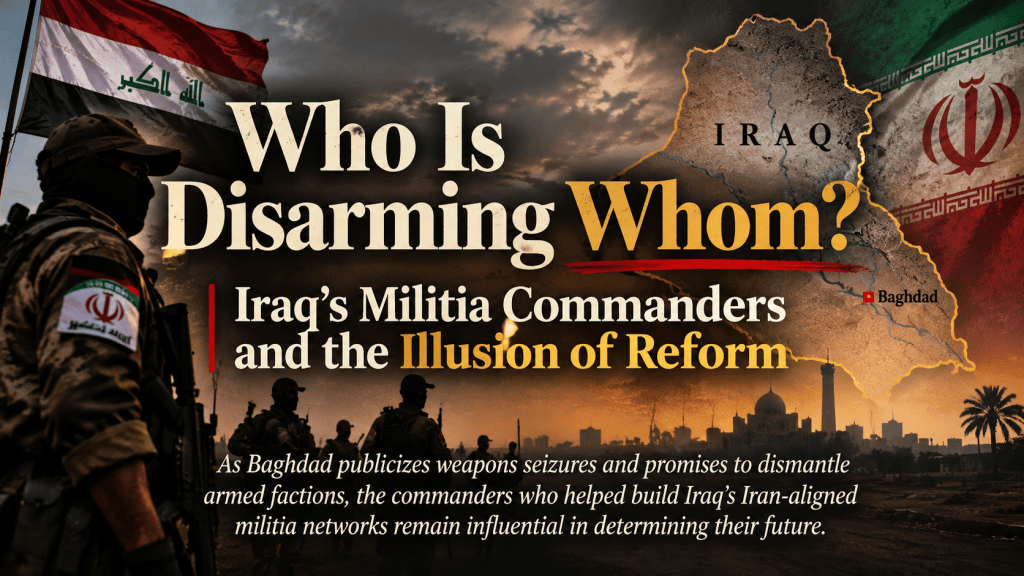
As Baghdad publicizes weapons seizures and promises to dismantle armed factions, the commanders who helped build Iraq’s Tehran-aligned militia networks remain influential in determining their future.
By Adrian P. Calamel
Iraq’s latest attempt to bring its powerful militias under state authority has reached a revealing moment. Prime Minister Ali al-Zaidi’s government has confronted Kataib Hezbollah over allegations of large-scale oil smuggling from Jurf al-Sakhar, a militia stronghold south of Baghdad. Government forces were prepared to enter the area, and Kataib Hezbollah threatened resistance. Yet rather than a decisive assertion of state authority, the confrontation has produced a negotiated compromise involving senior Iraqi political figures and Iran’s Islamic Revolutionary Guard Corps-Quds Force.
Under the reported arrangement, Iraqi security forces will enter Jurf al-Sakhar while Kataib Hezbollah fighters relocate elsewhere. The agreement may avert an armed confrontation, but it raises a far more important question: has Baghdad established control over the militia, or merely negotiated the terms under which its fighters will move?
This distinction goes to the heart of Iraq’s broader disarmament initiative. For years, successive Iraqi governments have promised to establish a monopoly over the use of force. Yet the country’s most powerful Iran-aligned organizations have repeatedly demonstrated that their authority does not depend exclusively on operating outside the state. They have built positions within its security institutions, political system, and economy.
The result is a contradiction that Baghdad has never adequately resolved. The very organizations whose independent military power is supposed to be dismantled remain deeply embedded in the institutions expected to carry out that dismantlement.
The question is no longer simply whether Iraq’s militias will surrender their weapons. It is who will control those weapons, the personnel operating them, and the institutions responsible for enforcing disarmament.
The Commanders Behind the Process
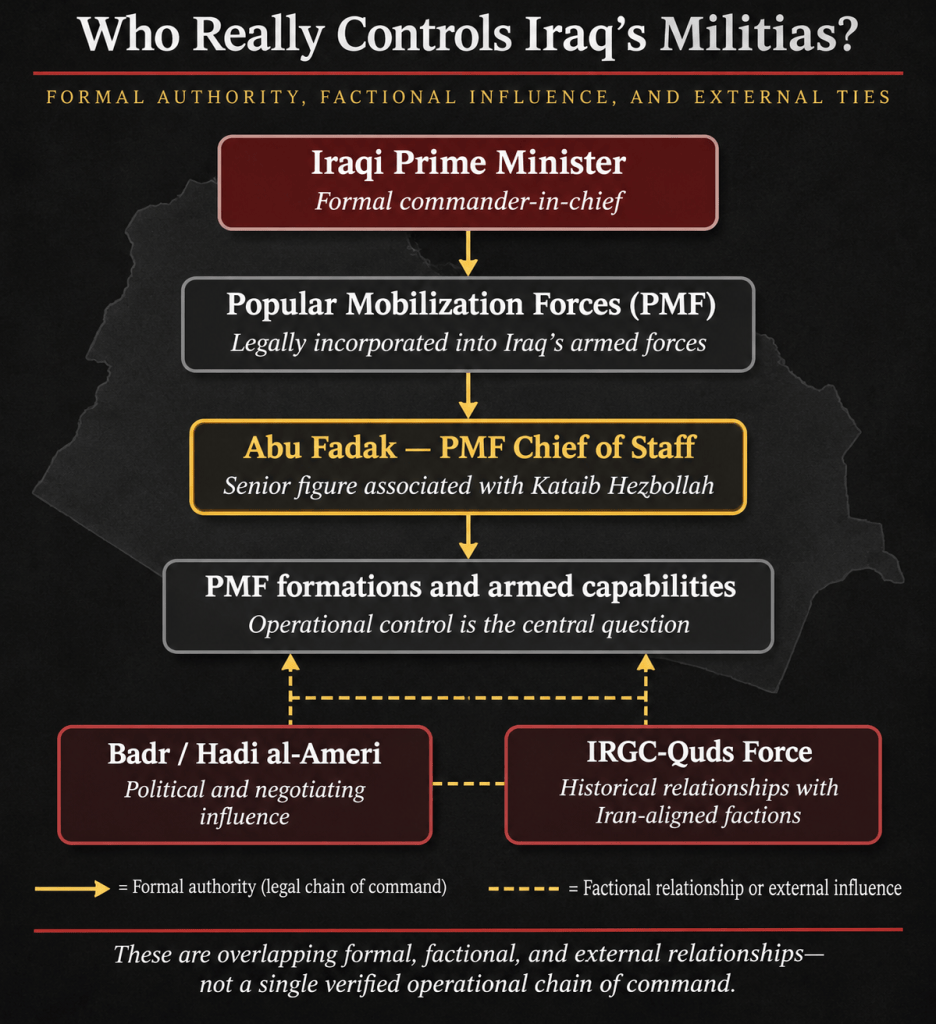
Two individuals illustrate the fundamental problem: Abdul-Aziz al-Muhammadawi, better known as Abu Fadak, and Hadi al-Ameri, the longtime leader of the Badr Organization.
Abu Fadak occupies one of the most consequential positions within Iraq’s Popular Mobilization Forces (PMF), serving as its chief of staff. He emerged from Kataib Hezbollah, one of Tehran’s most important Iraqi partners, and succeeded Abu Mahdi al-Muhandis as a central figure within the PMF’s military leadership following Muhandis’s death in January 2020.
Muhandis had been instrumental in establishing the relationship between the PMF’s Tehran-aligned factions and the Quds Force under Qassem Soleimani. His death did not eliminate those networks. Abu Fadak’s subsequent rise demonstrated their institutional continuity.
The PMF formally answers to Iraq’s commander-in-chief, the prime minister. Yet the existence of a legal chain of command does not necessarily establish effective operational control. Command authority must be measured by who issues orders, who obeys them, and whether individual formations can undertake military activities without authorization from the Iraqi government.
Abu Fadak’s position is therefore not merely an administrative detail. It places a senior figure associated with Kataib Hezbollah near the center of an institution expected to absorb or regulate armed factions, including organizations that have resisted surrendering their independent military capabilities.
Hadi al-Ameri represents a different but equally important dimension of the problem.
As the leader of Badr, al-Ameri has spent decades operating at the intersection of Iraqi politics, armed power, and Iranian influence. Badr’s transformation from a Tehran-backed armed organization into a major political and security actor illustrates how militia networks can acquire institutional legitimacy without necessarily abandoning their original relationships.
Al-Ameri’s influence in negotiations surrounding disarmament raises the question of whether reform is being shaped by independent state authorities or negotiated among the very factions whose military autonomy is at issue.
These are distinct forms of influence. Abu Fadak represents the operational and institutional dimension; al-Ameri represents political negotiation and factional accommodation. Together, they illustrate how armed organizations can retain leverage over a process ostensibly intended to reduce their power.
Jurf al-Sakhar: A Test of State Authority
The confrontation at Jurf al-Sakhar provides an unusually clear illustration of the problem.
Iraqi authorities have accused Kataib Hezbollah of participating in an extensive oil-smuggling operation involving state-owned resources. The militia denies wrongdoing. The allegations prompted dismissals of senior officials, an investigation, and preparations for a government security deployment into territory long controlled by the organization.
But the dispute quickly exposed the limitations of Baghdad’s authority.
Reporting indicated that an initial investigation faced restrictions on access to sites within the district. Subsequent arrangements reportedly involved PMF officials and inspections of agreed locations rather than unrestricted examination. The government eventually prepared a more substantial security operation, bringing it into direct confrontation with Kataib Hezbollah.
The ensuing negotiations involved al-Ameri and other senior figures, while Quds Force commander Esmail Qaani traveled to Baghdad as tensions escalated.
This is an extraordinary situation for a sovereign state attempting to establish control over its own territory.
A government seeking to enforce its laws against an armed organization formally subordinate to its commander-in-chief found itself negotiating with that organization while a senior Iranian military official participated in efforts to resolve the confrontation.
Nevertheless, a negotiated redeployment is not the same as disarmament.
If Kataib Hezbollah’s fighters move elsewhere while retaining their weapons, commanders, intelligence capabilities, and organizational relationships, the government will have altered the geographical distribution of armed power without necessarily reducing it.
The critical question is what happens after the television cameras leave.
Weapons Seizures and the Appearance of Progress
Baghdad has strong incentives to demonstrate progress to Washington and the international community. Publicized seizures, inspections, weapons handovers, and security deployments can provide visible evidence that the government is acting against armed groups.
Some of these actions may represent genuine enforcement. The confrontation over Jurf al-Sakhar may demonstrate that the government is prepared to challenge at least certain activities associated with Kataib Hezbollah.
But visible enforcement should not be confused with a comprehensive reduction in militia capabilities.
A warehouse of confiscated rifles may make compelling television. It tells observers little about the fate of missile inventories, armed drones, explosives, weapons-production facilities, or the networks responsible for identifying targets and planning operations.
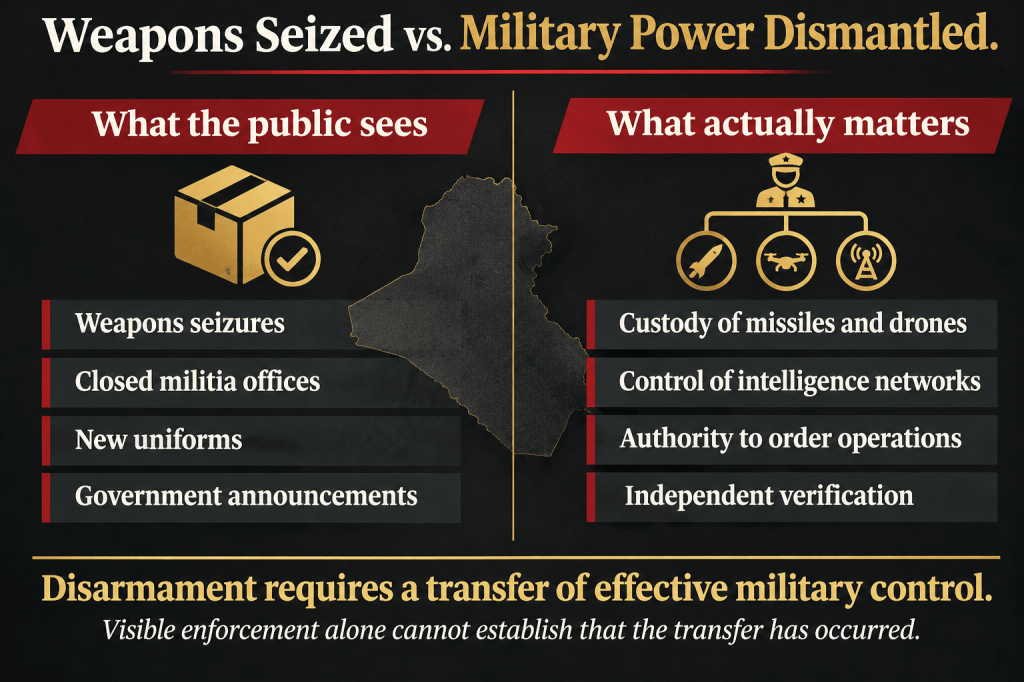
Nor does the seizure of equipment necessarily establish that the faction controlling it has lost the capacity to replace or redeploy those weapons.
This is where public presentation can diverge from military reality.
The danger is not necessarily that every reported seizure is fabricated. It is that genuine but limited seizures can be presented as evidence of a much more consequential transformation than has actually occurred.
If the government cannot independently establish what weapons each faction possesses, where those weapons are stored, and who controls their deployment, it cannot credibly claim that the factions have been disarmed.
And if the officials responsible for implementing the process remain dependent on negotiations with militia commanders, the problem becomes more fundamental.
Who is actually enforcing disarmament, and who is deciding its limits?
Integration Is Not Disarmament
In my earlier analysis, Follow the Weapons, Not the Uniforms: Iraq’s Militia “Disarmament” Test, I argued that Iraq’s proposed solution risked institutionalizing the very networks it was supposed to dismantle.
The distinction remains essential.
Disarmament concerns weapons and military capabilities. Dissolution concerns the dismantling of independent organizational structures. Integration concerns the incorporation of personnel into recognized state institutions.
These processes are related, but they are not interchangeable.
A militia can dissolve its public-facing organization while retaining its leadership and operational networks. Its members can receive new uniforms, identification cards, and government salaries without abandoning their previous loyalties. Weapons can be transferred between nominally state-controlled formations while remaining accessible to the same factional commanders.
Iraq’s PMF already demonstrates the difficulty.
Established during the war against the Islamic State and formally incorporated into Iraq’s armed forces in 2016, the PMF brought together formations with widely differing political loyalties and institutional histories. Some were closely associated with Tehran, while others maintained different relationships with Iraqi political and religious authorities.
Formal incorporation did not eliminate these distinctions.
Indeed, several factions developed a dual existence: recognized components of the Iraqi security establishment while simultaneously participating in armed networks whose decisions did not always follow Baghdad’s orders.
The proposed integration of additional militia personnel into the PMF therefore risks repeating a process whose limitations are already evident.
The organizational chart may change. The command relationships may not.
The Tehran Dimension
No credible assessment of Iraqi militia disarmament can ignore the role of the IRGC-Quds Force.
Tehran’s influence in Iraq extends beyond the provision of weapons or financial assistance. It has historically involved cultivating political relationships, developing armed organizations, facilitating training, and maintaining networks capable of advancing Tehran’s strategic objectives.
The PMF’s formal incorporation into the Iraqi state did not automatically sever those relationships.
The arrival of Esmail Qaani in Baghdad during the Jurf al-Sakhar confrontation illustrates the continuing importance of this external dimension.
His reported participation in efforts to avert a confrontation does not, by itself, prove that Tehran dictated the resulting agreement. But it demonstrates that Iran remains an influential actor when disputes arise between Baghdad and one of its most important Iraqi militia partners.
That fact should concern anyone evaluating the credibility of the disarmament process.
A state that has achieved exclusive control over its armed forces should not need an external military power to help negotiate compliance from organizations legally subordinate to its own government.
Nor should the continued participation of Tehran-aligned commanders in Iraq’s security institutions be treated as an incidental feature of the process.
The central question is whether the relationship between these factions and the Quds Force is being dismantled, reduced, or simply adapted to a new institutional arrangement.
Until that question can be answered, claims of genuine disarmament remain premature.
The Test Washington Should Apply
Washington should resist the temptation to judge Iraq’s progress through photographs of seized weapons, announcements of militia dissolution, or the number of fighters formally transferred into the PMF.
Those indicators may demonstrate activity. They do not necessarily demonstrate a transfer of military power.
The more meaningful test consists of four questions.
First, who has custody of the heavy weapons, missiles, drones, and production facilities previously controlled by Iran-aligned factions?
Second, have the independent intelligence, targeting, communications, and logistical networks supporting those capabilities been dismantled or placed under effective Iraqi state control?
Third, who can authorize the deployment of these forces, and what happens when factional commanders refuse an order from Baghdad?
Finally, have the operational relationships connecting these organizations to the IRGC-Quds Force been severed, or do they remain capable of influencing military decisions?
These are not abstract questions. They determine whether Iraq is establishing a genuine monopoly over the use of force or merely reorganizing competing centers of armed power beneath a common institutional label.
The Iraqi government faces real constraints. Attempting to dismantle powerful militias by force could trigger serious internal conflict. Negotiation may therefore be necessary, and incremental reforms may be preferable to a confrontation the state cannot control.
But the need for negotiation does not justify describing every negotiated concession as disarmament.
A realistic assessment must distinguish between reducing immediate tensions and eliminating the military autonomy that produced those tensions in the first place.
Who Is Disarming Whom?
The developments surrounding Jurf al-Sakhar have brought Iraq’s central contradiction into sharper focus.
The government very publicly demonstrated a “willingness” to confront Kataib Hezbollah, but the resulting negotiations have also revealed the continued influence of militia leaders, PMF officials, and Iran’s Quds Force over the outcome.
That does not establish that every government action is theatrical or that genuine reform is impossible.
It does, however, demonstrate why publicized weapons seizures and promises of integration are insufficient measures of success.
The deeper problem is that Iraq’s armed factions have spent years embedding themselves within the very institutions intended to control them. Their influence extends through military command, political representation, economic interests, and relationships with Tehran.
Disarmament that leaves these structures untouched risks becoming little more than an administrative exercise.
Baghdad may close militia offices, relocate fighters, redistribute weapons, and announce new chains of command. Washington may welcome the visible progress. The public may be shown confiscated weapons and told that the state is finally asserting its authority.
But if the same commanders retain effective control over the armed networks, the essential balance of power will remain unchanged.
Iraq will not have dismantled the militia system. It will have renegotiated the terms under which that system operates.
And that returns us to the question at the center of the entire process:
Who is disarming whom?


