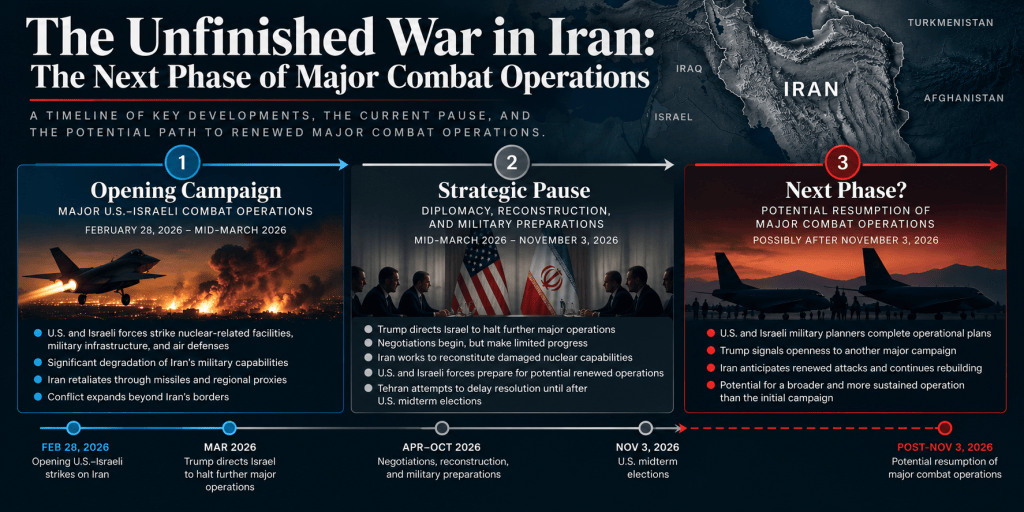
The war against Tehran is not over. It has entered a period of reduced military intensity that has been mistaken by some observers for the beginning of its conclusion. The fundamental issues that brought the United States, Israel, and the Islamic Republic into direct conflict remain unresolved. Tehran’s nuclear ambitions have not disappeared, the fate of its enriched uranium remains a critical concern, and the surviving leadership of the Islamic Republic continues to resist the concessions Washington and Jerusalem consider necessary.
I assess that another phase of major U.S.–Israeli combat operations is approaching. The question is not simply whether the regime will face additional strikes, but whether the next campaign will seek to accomplish what the opening phase of the war could not: eliminate Tehran’s ability to reconstruct its nuclear and military capabilities.
The timing is central to this assessment. President Donald Trump has had compelling political and economic reasons to avoid renewed large-scale operations before the November 3 American midterm elections. Tehran, recognizing those constraints, appears to have attempted to prolong negotiations and carry the conflict beyond the election. What Tehran may have interpreted as a strategic opportunity, however, could prove to be little more than a temporary reprieve.
The first phase of the war demonstrated the destructive capabilities of the United States and Israel. The months that followed have demonstrated the limitations of military success without a lasting political or strategic settlement. The coming weeks may determine whether Washington and Jerusalem intend to accept those limitations or resume operations on a scale comparable to the opening campaign.
A Military Campaign That Did Not Finish the War
When the United States and Israel launched their major military campaign against Tehran on February 28, 2026, they demonstrated the ability to strike critical elements of the Islamic Republic’s military and security infrastructure. Nuclear-related facilities, missile capabilities, air defenses, and command structures became central to a confrontation that rapidly expanded beyond Tehran’s borders.
Yet the ability to destroy facilities is not the same as the ability to eliminate a nuclear program.
Tehran’s nuclear capabilities are not confined to buildings, centrifuges, or enrichment sites. They include accumulated technical expertise, personnel, industrial infrastructure, and enriched uranium whose present condition and location must be established through credible verification. Even extensive physical destruction cannot guarantee that a determined government will abandon the objective of rebuilding.
This distinction has defined the unresolved strategic problem since the opening campaign.
The United States and Israel inflicted considerable damage, but the Islamic Republic survived, for now. Its remaining political and security institutions retained the ability to govern, repress domestic opposition, negotiate with foreign governments, and pursue the reconstruction of damaged capabilities.
The subsequent reduction in the intensity of combat should therefore not be confused with a settlement. The war’s most consequential objectives remain contested.
Trump’s decision to restrain further escalation was especially important. Israel has consistently viewed the continued existence of the Islamic Republic’s hostile security establishment as a long-term strategic threat. Washington, however, has had to weigh the benefits of further military action against the risks of regional escalation, American casualties, and disruption to global energy markets.
Those considerations help explain why the United States might interrupt an intensive military campaign without abandoning the possibility of resuming it.
A pause can be politically useful even when it is strategically unsatisfactory.
The Political Logic of the Pause
The approaching American midterm elections have imposed an additional constraint on Trump’s decision-making.
The war has already demonstrated the vulnerability of regional energy infrastructure and maritime commerce to IRGC retaliation. The Strait of Hormuz remains a central instrument of regime leverage, while attacks and threats involving Gulf infrastructure have exposed the broader economic consequences of renewed escalation.
For an American president approaching a closely contested congressional election, another major campaign carries substantial risks. A renewed surge in energy prices, prolonged disruption to shipping, or American military casualties could dominate the final days of the campaign.
Trump’s public position increasingly reflects this timing.
He has stated that the United States would not launch renewed attacks before the November 3 elections. That declaration does not mean the administration has abandoned military options. It establishes a political boundary that may cease to apply once the elections are over.
This is a crucial distinction.
Washington may have reduced the immediate intensity of the conflict not because it concluded that its objectives had been achieved, but because the political and economic costs of continuing major combat operations had become temporarily unacceptable.
Diplomacy provided an additional reason to maintain the pause. Negotiations offered the possibility, however remote, of obtaining concessions without another sustained military campaign. They also allowed Washington to maintain pressure on Tehran while preserving military options.
But diplomacy can serve different purposes for the parties involved.
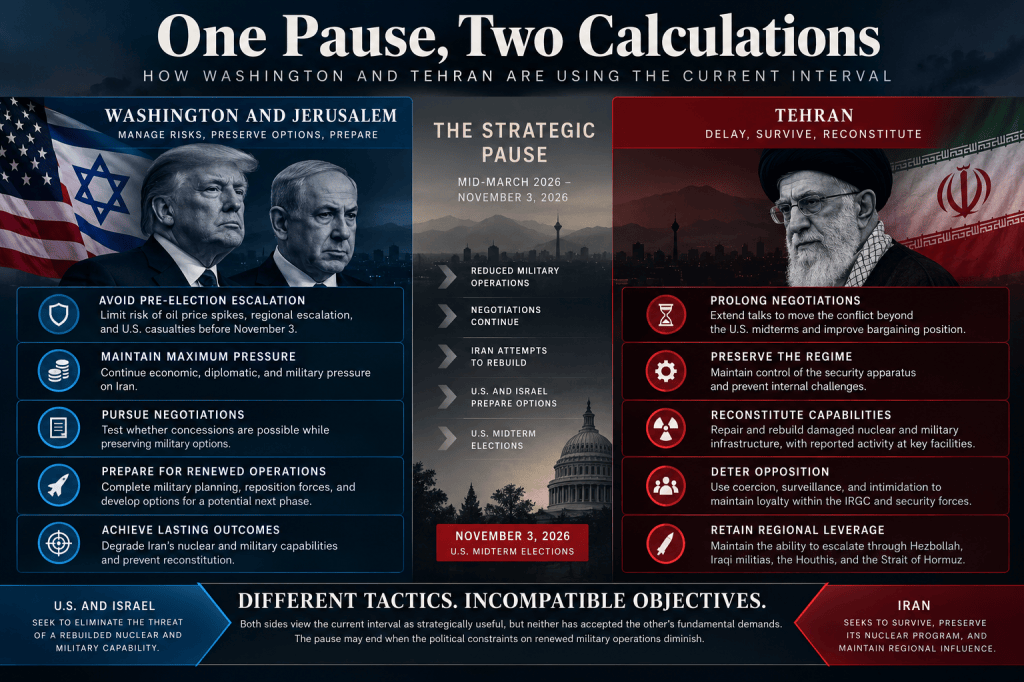
For Washington, negotiations may represent an attempt to secure an outcome that military strikes alone cannot guarantee. For Tehran, they may provide an opportunity to delay decisions, preserve the existing leadership, and recover from military losses.
The same negotiations can therefore be understood by one side as a path toward resolution and by the other as a means of postponing an unfavorable outcome.
That possibility is central to understanding Tehran’s behavior during the pause.
Tehran’s Strategy: Survive, Delay, and Reconstitute
The Islamic Republic has repeatedly demonstrated that institutional survival takes precedence over other considerations. Its leaders have endured economic sanctions, international isolation, internal unrest, and military pressure while preserving the central structures of the state.
In the present confrontation, time has become one of Tehran’s most important strategic resources.
Reuters reported on October 20 that senior regime officials acknowledged deliberately prolonging negotiations in an effort to weaken Trump politically ahead of the American midterms. According to that reporting, regime officials expected renewed U.S. and Israeli attacks and were preparing for further military action rather than anticipating an imminent negotiated settlement.
This is an important indication of Tehran’s calculations. The leadership does not necessarily regard the current period as a transition toward peace. It may instead view it as an interval in which to improve its position before the next confrontation.
There are several dimensions to this strategy.
First, prolonged negotiations postpone the moment when Tehran must accept or reject the most consequential American demands. Tehran has resisted surrendering control over its nuclear program and has sought concessions involving sanctions, maritime restrictions, and the wider conflict before substantive nuclear negotiations can advance.
Second, the pause provides opportunities to restore damaged infrastructure. Satellite imagery and expert assessments have raised concerns about reconstruction at facilities associated with sensitive nuclear-related activities. Such activity does not by itself establish that Tehran has restored operational weapons-development capabilities. It does, however, underscore the difficulty of ensuring that damage inflicted during an earlier campaign remains permanent.
Third, the IRGC retains the ability to impose costs through regional escalation. The Strait of Hormuz, the Houthis, Iraqi militias, and other Tehran-aligned actors offer different forms of pressure against American interests and regional partners.
These instruments are not interchangeable, and Tehran does not exercise identical control over every organization. Nevertheless, the broader network remains relevant to Tehran’s calculations about deterrence and retaliation.
There is also a significant risk in Tehran’s approach.
By delaying a settlement until after the American elections, regime leaders may be removing one of the principal political constraints on renewed U.S. military operations.
The regime may believe that prolonging the conflict will improve its bargaining position. But the same passage of time could allow Washington and Jerusalem to refine their plans, replenish military resources, and prepare a more extensive campaign.
Tehran may have succeeded in postponing the next phase of the war without doing anything to prevent it.
Trump’s Changing Language and the Indicators of Renewed Operations
The most consequential developments are no longer confined to diplomatic exchanges. They are increasingly visible in American rhetoric and reporting on military preparations.
On October 7, Axios reported that the Pentagon had instructed U.S. Central Command to complete preparations for the possible resumption of major combat operations against Tehran. The report emphasized that Trump had not made a final decision, but the directive indicated that military planning had progressed beyond a general contingency.
By October 22, ABC News reported that American and Israeli military planners had developed plans for renewed joint strikes. Israeli sources familiar with the preparations expected any major operation to follow the November 3 midterms. The report also described repositioning of American military personnel in the region, while U.S. officials declined to confirm any specific operational plan.
The following day, Trump’s own language became more explicit.
Speaking in Florida on October 23, he raised the possibility of another Operation Epic Fury. On the same day, he publicly questioned whether the United States should bring the war to a rapid conclusion or allow the regime to weaken over time.
Those statements are significant because they suggest that the administration is still considering options that extend beyond maintaining the present level of military and economic pressure.
Trump’s language has not been entirely consistent. He continues to refer to the possibility of a negotiated agreement, and he has publicly ruled out immediate attacks on particular occasions. These statements should not be ignored. They may reflect an administration attempting to preserve maximum flexibility while increasing pressure on Tehran.
Nevertheless, the convergence of military planning, political timing, and increasingly direct threats warrants attention.
Any one of these indicators could be explained as coercive diplomacy. Together, they suggest that renewed combat operations are being treated as a practical option rather than an abstract possibility.
There is an important distinction between preparations for war and a final decision to initiate it. Governments frequently prepare military options they never execute.
Yet in this case, those preparations are occurring during an active conflict whose principal disputes remain unresolved. Both sides anticipate further confrontation, and the American president has explicitly identified a period during which he does not intend to authorize renewed attacks.
That makes the period following November 3 especially significant.
My assessment is that the present reduction in combat intensity is approaching its limits. The political reasons for postponement may soon diminish, while the strategic reasons for resuming operations remain.
The Problem Washington Has Not Solved
The Islamic Republic’s regional network remains relevant even after substantial military pressure against the regime and its allies.
Hezbollah has suffered serious setbacks, and the wider regional environment has changed significantly. Yet organizational weakness does not necessarily mean an inability to participate in renewed escalation.
Tehran-aligned Iraqi militias also remain important to Tehran’s strategic position. Their political relationships, access to weapons, and connections with elements of the Iraqi security establishment complicate any effort to treat them as independent of the regional confrontation.
The Houthis present a different challenge. Their ability to threaten maritime commerce and regional infrastructure creates risks that extend beyond the immediate military balance between Tehran, Israel, and the United States.
The Strait of Hormuz remains especially important because it allows Tehran to influence the economic consequences of the war far beyond the battlefield.
These capabilities help explain why Trump has been cautious about renewing major operations before the midterms. They also help explain why Tehran believes it can continue resisting American demands.
But there is a difference between possessing the ability to impose costs and possessing the ability to prevent an adversary from acting.
Tehran’s regional instruments can complicate renewed U.S.–Israeli operations, widen the conflict, and increase economic damage. They cannot necessarily protect the Islamic Republic from another intensive campaign.
Indeed, an attempt to use those instruments more aggressively could strengthen the argument in Washington and Jerusalem for expanding the scope of military operations.
That is one of the central dangers facing Tehran as the pause approaches its possible end.
Why Another Major Campaign Is Approaching
There is an alternative interpretation of current developments.
Trump may be using increasingly explicit military threats to extract concessions from Tehran. Reported military preparations may be intended to reinforce diplomacy, reassure Israel, and persuade regime leaders that the cost of continued resistance will rise.
Under this interpretation, the administration could continue a strategy of sanctions, maritime pressure, limited military operations, and negotiations without returning to the intensity of the opening campaign.
That possibility cannot be dismissed.
However, it leaves the underlying problem unresolved.
For the Islamic Republic, the nuclear program has long been regarded as essential to regime survival, providing both strategic deterrence and leverage against foreign adversaries. Yet Khamenei understood that the greatest threat to the regime’s survival came not necessarily from Washington or Jerusalem, but from the Iranian people themselves. The nuclear program could help deter external intervention, but it could not protect the regime from internal dissent, widespread unrest, or the potential collapse of loyalty within its own security apparatus.
Washington and Jerusalem, meanwhile, have little reason to accept a settlement that leaves Tehran able to restore capabilities they have already fought a war to destroy.
The negotiating positions therefore reflect a conflict that goes beyond technical questions of enrichment.
For Tehran, retaining nuclear capabilities and preserving the security establishment are bound up with the survival of the regime. For Washington and Jerusalem, the continued ability of that establishment to reconstruct its military and nuclear capabilities remains a persistent threat.
The longer the confrontation continues without a settlement, the more difficult it becomes to treat the current military pause as a durable outcome.
The approaching American midterms add a further consideration.
If Tehran’s leaders deliberately sought to prolong negotiations until after November 3, they may have misjudged the implications of that strategy. The election may remove an important reason for Trump to defer major operations, without changing the administration’s underlying demands.
The combination of unresolved objectives, Tehran’s reconstruction efforts, renewed military preparations, and Trump’s increasingly explicit public statements leads me to conclude that another substantial phase of combat operations is approaching.
The precise timing remains uncertain. So do the scale, duration, and ultimate objectives of the next campaign.
But the direction of the confrontation is becoming clearer.
Conclusion: A Pause Is Not a Peace
The opening phase of the Tehran war demonstrated that the United States and Israel possess the military capabilities to inflict extensive damage on the Islamic Republic. It did not establish that Tehran’s nuclear ambitions had been eliminated, that its enriched uranium had been secured, or that its surviving leadership had accepted the strategic demands of its adversaries.
The subsequent pause created a period in which both sides could reassess their positions.
Trump gained time to manage the political and economic consequences of the war before the American midterms. Tehran gained time to preserve its governing institutions, prolong negotiations, and attempt to restore damaged capabilities.
Neither side appears to have abandoned its fundamental objectives.
This is why the current period should be understood as an interval within an unfinished war rather than evidence of a lasting settlement.
I expect major U.S.–Israeli combat operations against Tehran to resume, after the November 3 elections, with expanded target packages and military objectives.
Whether the next campaign is intended to impose a settlement, further degrade Tehran’s military capabilities, or create conditions for a more fundamental political change remains to be seen.
What is increasingly difficult to sustain is the assumption that the existing pause can continue indefinitely while the central causes of the conflict remain untouched.
Tehran may have bought itself time. It has not necessarily bought itself safety.
The first phase of the war did not settle the conflict. The next may determine whether Washington and Jerusalem intend to do so.


