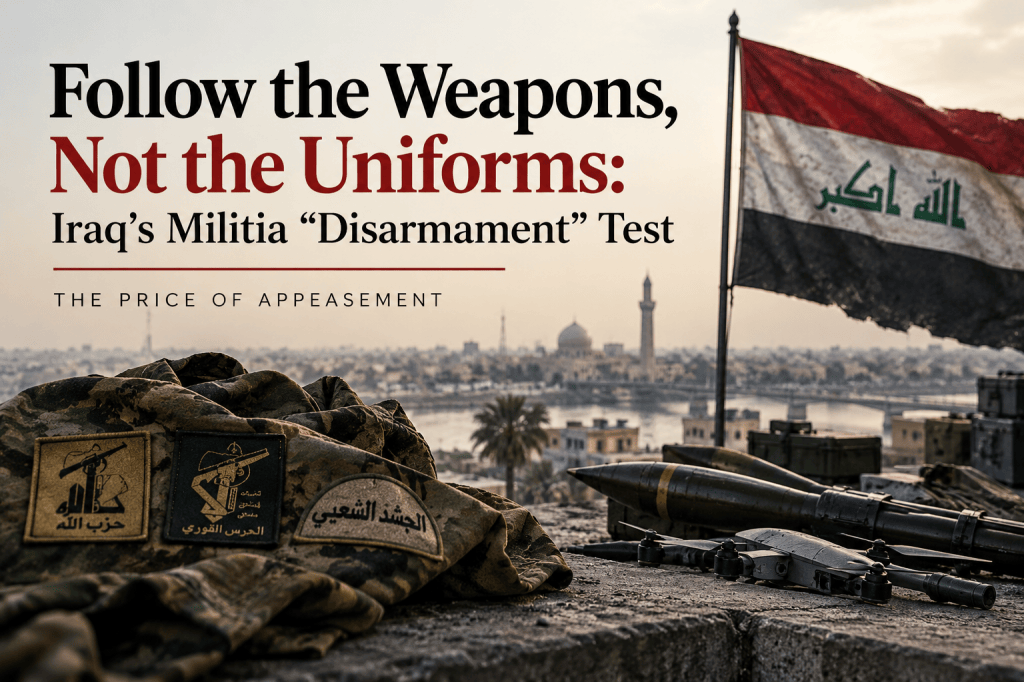
Integrating Iran-aligned militias into the Popular Mobilization Forces will mean little if their weapons, command structures and external relationships survive the transition.
Baghdad’s Promise of “Disarmament”
Iraq may be approaching what appears to be a watershed moment in its long struggle to bring armed groups under the authority of the state. Baghdad is pursuing an agreement under which Tehran-aligned militias would relinquish their independent status, with members incorporated individually into the Popular Mobilization Forces and armed groups continuing to operate outside the state potentially treated as unlawful. On paper, it sounds like the beginning of the end of Iraq’s militia problem.
But there is a fundamental distinction being lost in the discussion: integration is not disarmament.
The Popular Mobilization Forces are not a neutral destination outside the militia system. They are already the legal umbrella beneath which many of Iraq’s most powerful Tehran-aligned armed factions have operated. Moving additional militia personnel into that structure may eliminate independent organizational names and bring more fighters formally onto the state payroll, but neither necessarily eliminates the military networks that gave those organizations their power.
The real measure of disarmament, therefore, cannot be how many militia offices close, how many factional names disappear, or how many fighters are formally incorporated into the PMF. It must be measured by something far more concrete: Who controls the weapons?
Where will the missiles and drones go? Who will retain the intelligence and targeting networks behind them? And, most importantly, will integration sever the operational relationships connecting Tehran-aligned proxies in Iraq to the Islamic Revolutionary Guard Corps-Quds Force?
If those capabilities and command relationships survive the transition, Iraq will not have disarmed Tehran’s proxy network, it will have institutionalized it, moving armed power that once operated through identifiable militia organizations more deeply inside the structures of the Iraqi state.
The Distinction Washington and Baghdad Cannot Afford to Blur
The language surrounding Iraq’s militia question matters because three very different processes, disarmament, dissolution, and integration, can easily be presented as though they produce the same result. They do not. A militia can be dissolved without being disarmed, and its members can be integrated into a state institution without dismantling the military network from which they came.
Disarmament is the most concrete of the three. In conventional disarmament, demobilization, and reintegration (DDR) terminology, it means removing weapons from combatants and bringing those weapons, ammunition, explosives, and other military assets under controlled custody or disposing of them. The United Nations defines disarmament around the collection, documentation, control, and disposal of weapons; its current guidance describes the underlying objective more simply as reducing or eliminating access to weapons. In the Iraqi context, genuine disarmament therefore cannot be measured simply by whether a fighter turns in his rifle. The more consequential question is what happens to a faction’s missiles, armed drones, ammunition stocks, weapons-production facilities, and the infrastructure required to maintain and employ them.
Dissolution/demobilization is organizational. It means dismantling the militia as an independent military structure: its command hierarchy, units, offices, internal security and intelligence apparatus, and its ability to operate as a coherent armed organization. This is distinct from disarmament. A faction’s name and headquarters could disappear while many of the relationships that made it function survive elsewhere. Conversely, fighters could surrender certain weapons while the organization itself, its leadership, and its networks remain intact. International DDR practice similarly treats taking combatants out of armed groups or disbanding military structures as a separate step from collecting their weapons.
Integration is different again. It involves moving former militia personnel into a recognized state institution or security service. The UN explicitly recognizes integration into formal state uniformed services as one possible alternative pathway for former combatants. In Iraq, however, the destination matters enormously. The Popular Mobilization Forces are already legally part of the Iraqi armed forces: Iraq’s 2016 PMF law placed the organization within the armed forces and formally under the commander-in-chief. Moving militia members into the PMF can therefore regularize their legal status and place them within the state’s formal security architecture. But integration describes where the fighters go; it does not, by itself, tell us what happened to the armed network they belonged to.
That distinction is the heart of the issue. Baghdad could potentially accomplish integration without complete dissolution, and dissolution without complete disarmament. A militia’s name could disappear. Its members could receive new uniforms, salaries, ranks, and brigade assignments. Its former offices could close. On an organizational chart, the process could appear complete.
Disarmament concerns the weapons. Dissolution concerns the organization. Integration concerns the personnel. A policy that accomplishes only the third should not automatically be described as having accomplished the first two.
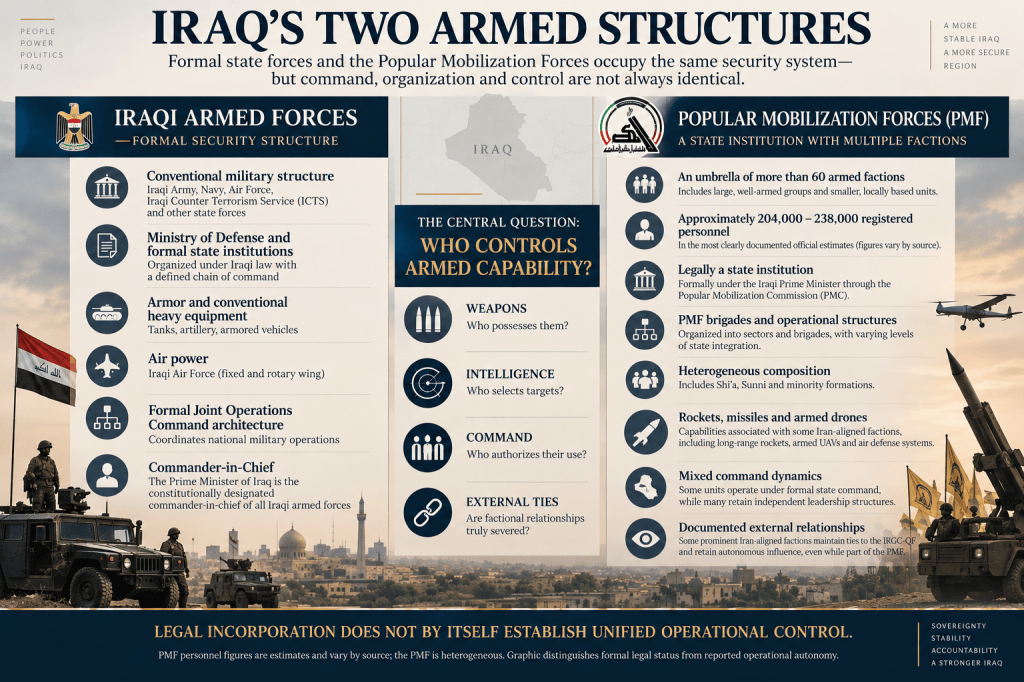
And that is why the test of Iraq’s militia agreement cannot end with the organizational chart. It has to begin with what happens after the names and uniforms change: follow the weapons.
The Problem with the PMF Solution
The difficulty with using the Popular Mobilization Forces as the vehicle for militia integration is that the PMF is not a new institution being created to absorb armed groups. It is itself the product of an earlier attempt to bring disparate armed formations inside the Iraqi state.
The Popular Mobilization emerged during the 2014 war against the Islamic State, when a wide range of armed groups and volunteers mobilized alongside Iraq’s conventional security forces. In 2016, parliament formalized that arrangement through Law No. 40, establishing the PMF as part of Iraq’s armed forces and placing it, at least legally, under the authority of the commander-in-chief. The law also required PMF personnel to separate themselves from political and partisan organizations.
That legal structure, however, did not transform the PMF into a single homogeneous military organization. It remained an umbrella encompassing formations with different histories, leadership structures, political affiliations, and external relationships. The formal chain of command, however, obscures where power actually resides inside the PMF. At its apex sits Abdul-Aziz al-Muhammadawi, better known as Abu Fadak, the PMF’s chief of staff and a senior Kataib Hezbollah commander. Abu Fadak is the most powerful figure within the PMF and holds the Iraq file for Tehran, placing a commander from one of Tehran’s most important Iraqi proxies at the center of the institution ostensibly responsible for bringing armed groups under state authority. This is the fundamental contradiction at the heart of proposals to solve Iraq’s militia problem through further integration into the PMF: changing organizational status does not necessarily change command relationships, loyalties, or control.
This distinction matters because formal incorporation and operational control are not necessarily the same thing. Iraq has already attempted repeatedly to subordinate PMF formations to a unified state chain of command. Yet some factions have simultaneously maintained identities as both registered PMF brigades and members of the broader muqawama, or resistance, network. The contradiction is therefore not theoretical. Iraq has already demonstrated that an armed organization can possess a place within the state’s formal security architecture while retaining a factional identity outside it.
This is what makes another round of integration into the PMF so difficult to evaluate. A fighter receiving a PMF identification card, government salary, rank, or brigade assignment tells us where that individual has been placed administratively. It does not necessarily tell us who commands him operationally or what happened to the organization from which he came.
Integration can reorganize personnel administratively without necessarily reorganizing the military power behind them. What matters is whether the capabilities that made the militia independently powerful have been transferred to effective state control.
The organizational chart can tell us where a fighter officially belongs. It cannot necessarily tell us who retains coercive power.
There is a much simpler way to determine whether Iraq’s militias are actually being disarmed:
Stop looking at the names of the organizations and follow the weapons.
Follow the Weapons, Not the Uniforms
If Iraq’s militia agreement is to amount to genuine disarmament, the most important evidence will not be found in organizational charts, new brigade numbers, or government payrolls. It will be found in what happens to the military capabilities that allowed these factions to operate independently in the first place. Recent reporting on Baghdad’s disarmament effort underscores the problem: several powerful Tehran-aligned factions possess advanced weapons and have resisted efforts to surrender their independent military power.
The first test is missiles and drones. Where are these weapons physically located after integration? Who possesses the launch systems? Who maintains them? And what happens to the facilities, technical personnel, supply chains, and components necessary to produce or repair them? These are not hypothetical capabilities. PMF formations associated with Kataib Hezbollah have previously exercised control over sophisticated drone capabilities, while Iran-aligned Iraqi factions have continued to employ missiles and drones in regional operations. If those capabilities remain under the effective control of the same networks after their organizational names disappear, the military balance has changed far less than the terminology suggests.
The second test is targeting and intelligence. A missile or drone is only the visible end of a much larger system. Someone identifies the target, collects intelligence, determines vulnerabilities, communicates coordinates, and makes the operational preparations necessary for an attack. This is particularly important because some Tehran-aligned factions have operated intelligence structures while simultaneously occupying positions within the state-funded PMF. Kataib Hezbollah, for example, has been assessed as exercising influence over important PMF functions including intelligence and missiles. Moving personnel into different PMF formations therefore means little if the intelligence networks that supported independent factional operations remain intact.
The third, and perhaps most important, test is command and control. Who can actually order these weapons to be used? Formally, PMF formations fall within an Iraqi state chain of command ultimately leading to the prime minister as commander-in-chief. In practice, however, the distribution of power inside the PMF tells a very different story. Its chief of staff, Abdul-Aziz al-Muhammadawi, better known as Abu Fadak, the PMF’s chief of staff and a senior Kataib Hezbollah commander with longstanding ties to Iran, and is the key military decision-maker within the PMF. His influence is reinforced by Kataib Hezbollah’s position within the institution, where its personnel occupy critical roles connected to intelligence, missiles, anti-armor capabilities, and special operations. This creates a fundamental distinction between formal authority and effective control. The prime minister may sit atop the PMF’s organizational chart, but the more consequential question is who exercises influence over its commanders, weapons, intelligence, and operational decisions. Integration into a state institution means little if the command relationships that existed outside the state remain intact within it.
The fourth test is the IRGC-Quds Force relationship. Any assessment of integration must account for the fact that Iranian influence is not simply external to the PMF; it has long reached into the institution’s senior command structure. Abu Mahdi al-Muhandis, Kataib Hezbollah’s founder and one of the Quds Force’s most important Iraqi partners, served as the PMF’s de facto operational commander until his death in 2020. His successor, Abu Fadak, emerged from the same Kataib Hezbollah network and today occupies the PMF’s highest military staff position while holding the Iraq file for Tehran. This does not mean that every PMF formation maintains an identical relationship with Tehran. They do not. But that distinction should not obscure the central question: whether the Iran-aligned factions supposedly being disarmed actually sever the operational, financial, intelligence, and command relationships that connect them to the Quds Force. If those networks remain intact, incorporation into the PMF cannot by itself constitute meaningful disarmament or the restoration of exclusive state control.
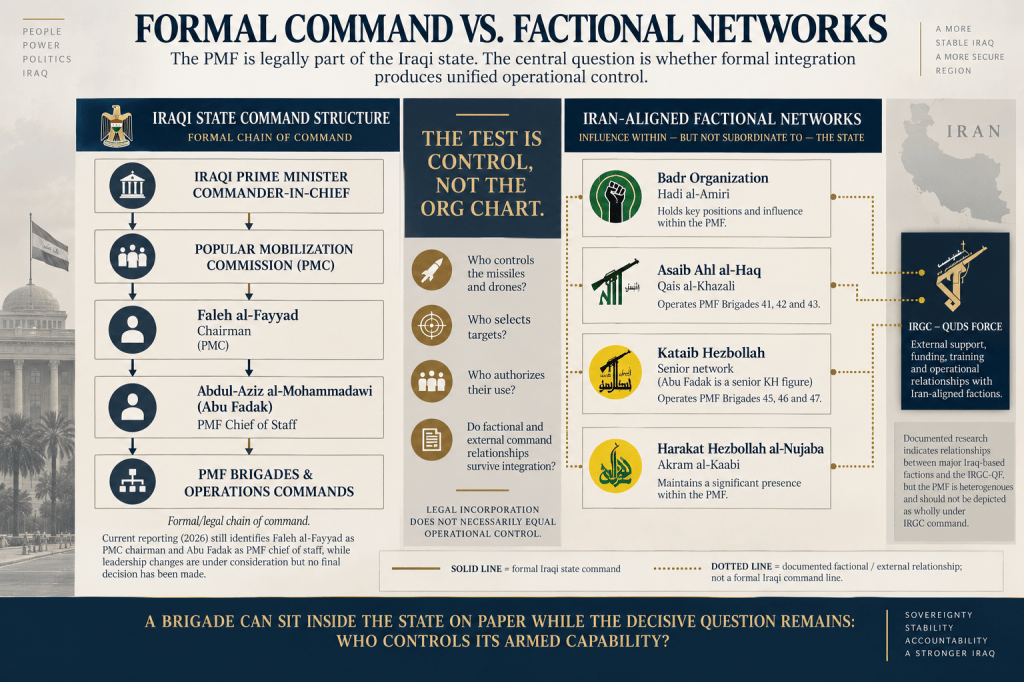
Disarmament is not determined by which flag hangs over the weapons. It is determined by who possesses them, who controls them, who can order their use, and whose strategic objectives they ultimately serve.
From Proxy Network to State Institution?
If those underlying capabilities and relationships survive integration, however, the direction of absorption becomes much less clear. Rather than the state absorbing the militia, the militia may instead have embedded itself more deeply within the state. It will have changed, shielded and institutionalized the setting in which that infrastructure operates.
The objective of integration is presumably to strengthen Baghdad’s authority by bringing armed actors into recognized state structures. If fighters enter the PMF, accept a unified chain of command, surrender independently controlled weapons, dismantle parallel intelligence structures, and sever outside operational relationships, integration could represent a meaningful consolidation of state power. The uniform would change because the underlying command relationship had changed with it.
But the opposite outcome is also possible. If former militia personnel enter the PMF while their commanders retain influence over them; if missiles, drones, and weapons-production capabilities remain accessible to the same networks; if factional intelligence structures survive; and if operational relationships with the IRGC-Quds Force continue, then the state has not necessarily absorbed the militia.
Many of these organizations already operate across multiple spheres. Political movements associated with major Iran-aligned factions have competed for parliamentary representation, while militia-linked personnel and organizations have operated within the state-funded PMF. Eliminating a militia’s independent name therefore does not necessarily eliminate the network connecting its military, political, economic, and institutional power.
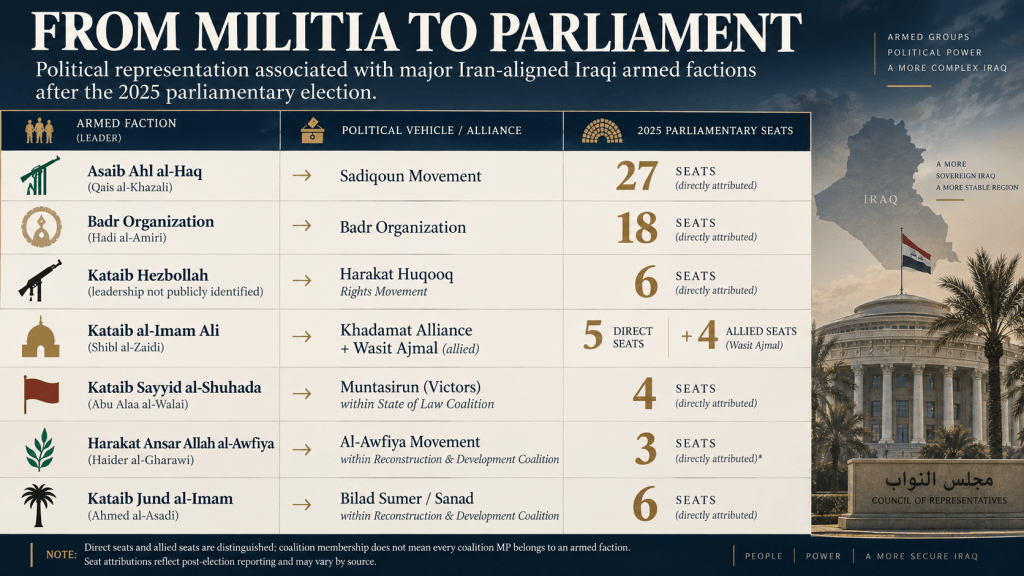
Under such a scenario, integration could provide former militia networks with a powerful combination: state salaries + legal status + institutional protection + continued military capability + continued factional relationships.
This is where the term institutionalization becomes important. The question is whether the network itself survives: its commanders, weapons, intelligence apparatus, political relationships, financing, and external connections. If those elements remain mutually reinforcing after formal integration, the disappearance of the militia’s name may obscure rather than demonstrate the disappearance of its power.
If the networks entering the PMF retain meaningful control over their weapons, command structures, and external relationships, Iraq will not have fully dismantled the proxy infrastructure it set out to contain. It will have changed, shielded and institutionalized the setting in which that infrastructure operates.
Washington Should Measure Capabilities, Not Compliance Announcements
For Washington, the temptation will be to measure success by what can be easily counted: how many factions announce their dissolution, how many militia offices close, how many fighters formally enter the Popular Mobilization Forces, and how many organizations disappear from the Iraqi security landscape. Those developments would be politically significant, but they would not, by themselves, demonstrate that the military capabilities of those organizations had disappeared or that Baghdad had gained effective control over them. This is particularly important when fighters and weapons are transferred into the PMF. Although the prime minister formally sits atop its chain of command, the PMF’s military command structure places considerable operational authority in the hands of Chief of Staff Abu Fadak, the senior Kataib Hezbollah commander who holds the Iraq file for Tehran. Moving personnel and capabilities from a Tehran-aligned faction into an institution in which Abu Fadak exercises such control cannot be treated as a transfer of control from the militia to the Iraqi state.
The United States has confronted this distinction before. Iraqi law already requires the PMF to operate within the state security structure and under government authority, yet U.S. government reporting has repeatedly documented cases in which particular Tehran-aligned PMF factions operated outside Baghdad’s effective command and control. The lesson is straightforward: formal compliance is not necessarily operational compliance.
Washington should therefore judge any militia agreement by changes in capabilities rather than changes in nomenclature. The relevant measures are whether missiles, rockets, drones, weapons stockpiles, and production or maintenance facilities have been transferred to effective state control; whether parallel intelligence, targeting, communications, logistics, financing, and procurement networks have been dismantled; and whether former militia commanders retain the ability to issue operational orders independently of Iraq’s recognized chain of command.
The same standard must apply to the external relationships that made some of these organizations more than conventional Iraqi militias. If the factions supposedly being disarmed retain operational relationships with the IRGC-Quds Force, their incorporation into the PMF would leave one of the most important elements of the existing structure unresolved.
None of this means organizational changes are irrelevant. Closing militia headquarters, ending independent recruitment, eliminating separate military identities, and incorporating personnel into a recognized state chain of command could all be components of a genuine consolidation of Iraqi sovereignty. The distinction is between treating those measures as evidence of a process and treating them as proof of its outcome.
Washington’s metric should therefore be control: control of the weapons, intelligence, command structure, logistics, and external operational relationships with Tehran.
If those measures have materially changed, Iraq may indeed be dismantling the autonomous military power of the factions.
If they have not, announcing that a certain number of organizations have “disarmed” will tell Washington very little has changed on the ground in Iraq.
The Test Comes After the Flags Come Down
If Iraq’s militia agreement proceeds as intended, its most visible signs of success may also be the least important. Offices can close. Factional names can disappear. Fighters can exchange militia insignia for PMF uniforms. Political leaders can announce that armed groups have accepted the authority of the state.
None of those developments would be meaningless. But none, on its own, would answer the central question raised throughout this article: has control over organized military power actually changed?
That answer will emerge only after the transition is underway.
Iraq has spent years attempting to reconcile two competing realities: the legal authority of the state and the persistence of armed organizations capable of exercising power through structures that do not always correspond neatly with the formal chain of command. The proposed integration process could narrow that divide. If weapons are genuinely centralized, parallel command structures dismantled, and personnel made accountable to Iraqi state authority, then integration could become part of a meaningful consolidation of state control. But if the uniforms change while the underlying relationships do not, the result will be fundamentally different.
The distinction ultimately comes down to something remarkably simple.
Integration changes where the fighters sit. Dissolution changes the organization around them. Disarmament changes who controls the power to use force.
The real test, therefore, begins after the militia offices close and the factional flags come down.
Where are the weapons? Who controls them? Who gives the orders? And whose strategic objectives do those weapons ultimately serve?
Those answers, not the names printed on an organizational chart, will determine whether Iraq has dismantled Tehran’s proxy infrastructure or merely moved parts of it more deeply inside the state.


