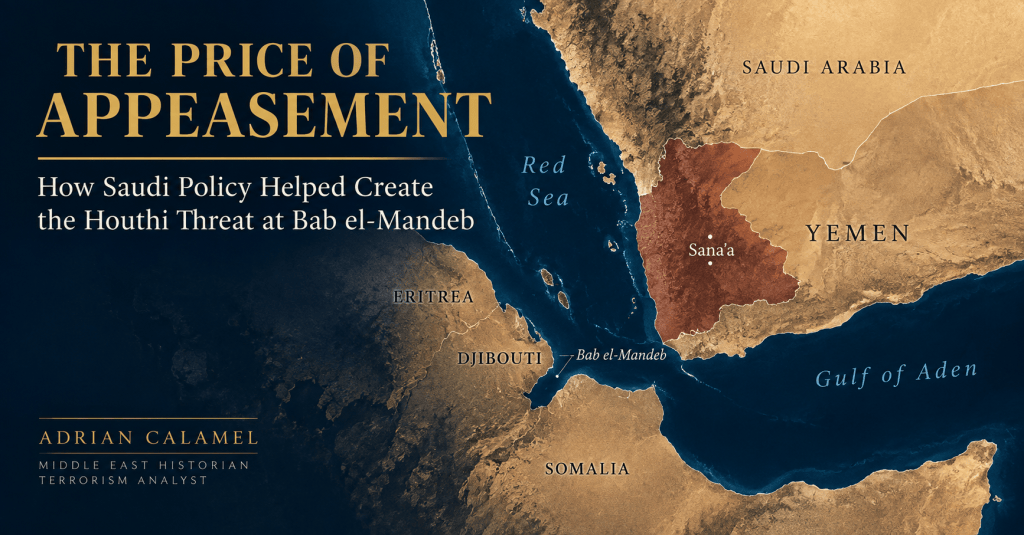
Riyadh sought peace with the Houthis while helping dismantle the southern security architecture that contained them. The consequences are now being felt far beyond Yemen.
The map of Yemen has changed, and with it the strategic balance surrounding one of the world’s most important maritime chokepoints. Houthi forces have advanced along Yemen’s Red Sea coast, seizing Mokha and expanding their presence on strategically important islands near the Bab el-Mandeb Strait. These gains place an Iranian-backed movement in an increasingly consequential position astride a critical artery connecting the Red Sea to the Gulf of Aden and the Indian Ocean. At the same time, instability surrounding the Strait of Hormuz has demonstrated once again how vulnerable global energy markets remain to disruption at the opposite end of the Arabian Peninsula.
For Saudi Arabia, the situation carries a particular irony. Riyadh spent years attempting to extricate itself from the Yemen war, pursuing accommodation with the Houthis while supporting a political reorganization of the anti-Houthi coalition. It sought a quieter border, a unified Yemeni political framework, and the stability necessary to concentrate on its economic transformation. Instead, Saudi Arabia now confronts a Houthi movement capable of threatening its territory and energy infrastructure while expanding its position along the Red Sea.
The support, weapons, and assistance provided by the regime in Iran are indispensable to understanding the Houthis’ rise. But they do not fully explain how the political and military environment in southern Yemen became so favorable to their latest advance. To understand that, Riyadh must also examine the consequences of its own policies.
Buying Quiet from the Houthis
The relative calm that followed the April 2022 UN-brokered truce offered Saudi Arabia something it had sought for years: a pathway out of an increasingly costly and seemingly interminable war. The truce dramatically reduced large-scale fighting, eased restrictions on fuel entering Hudaydah, and restored limited commercial flights from Sana’a. Even after the agreement formally expired that October, the reduction in hostilities largely held, creating an opportunity for Riyadh to pursue direct negotiations with the Houthis.
The Saudi calculation was understandable. After years of cross-border missile and drone attacks, Riyadh wanted a secure southern frontier and an end to a conflict that threatened the stability required for its ambitious economic transformation. But negotiations increasingly offered the Houthis tangible benefits without resolving the underlying military imbalance. The Houthis’ maximalist demands included fewer restrictions on Hudaydah, payment of public-sector salaries, including military and security personnel, and access to oil revenues.
The mistake was not negotiating with the Houthis. It was negotiating as though reduced Houthi attacks represented a fundamental change in the movement’s strategic ambitions or its relationship with the regime in Iran. Riyadh was negotiating with a Yemeni movement whose military capabilities could no longer be understood solely within the confines of Yemen’s civil war. Tehran had spent years providing the Houthis with weapons, technology, training, and other forms of support that had transformed the movement’s ability to threaten Saudi Arabia and maritime traffic. Riyadh increasingly mistook a suspension of Houthi aggression for moderation of Houthi intent. Diplomacy began to substitute for deterrence rather than reinforce it. Saudi Arabia was buying quiet, but quiet was not peace.
TWO ALLIES, TWO VISIONS FOR YEMEN
Saudi Arabia and the United Arab Emirates entered the Yemen war in 2015 as coalition partners with a common enemy, but they did not ultimately share the same vision for the country they were attempting to stabilize. Riyadh remained committed to an internationally recognized government presiding over a nominally unified Yemen, an arrangement that offered the Kingdom the prospect of a more predictable political order along its southern border. Abu Dhabi pursued a different strategy, cultivating local partners across southern Yemen and supporting forces that could secure territory, combat terrorist organizations, and protect the country’s southern coastline.
The most consequential of these relationships developed around the Southern Transitional Council (STC) and the security forces associated with it. The STC openly advocated restoring an independent southern state within the boundaries that existed before Yemeni unification in 1990. Its proposed constitutional order was explicitly non-secular: Islam would be the state religion and Islamic Sharia a principal source of legislation, alongside a civil, democratic and pluralistic political system. Yet the UAE-backed forces also developed substantial military and security capabilities on the ground, particularly around Aden and across parts of southern Yemen.
This distinction would become increasingly important. The STC’s political objectives were unquestionably contentious, and its forces were associated with serious allegations of abuses. But disagreement over the STC’s political project was not the same question as whether the security architecture associated with it served a strategic purpose. The strategic mistake was allowing disagreement over the STC’s political objectives to obscure the military function performed by the forces associated with it.
THE SECURITY ARCHITECTURE AROUND ADEN
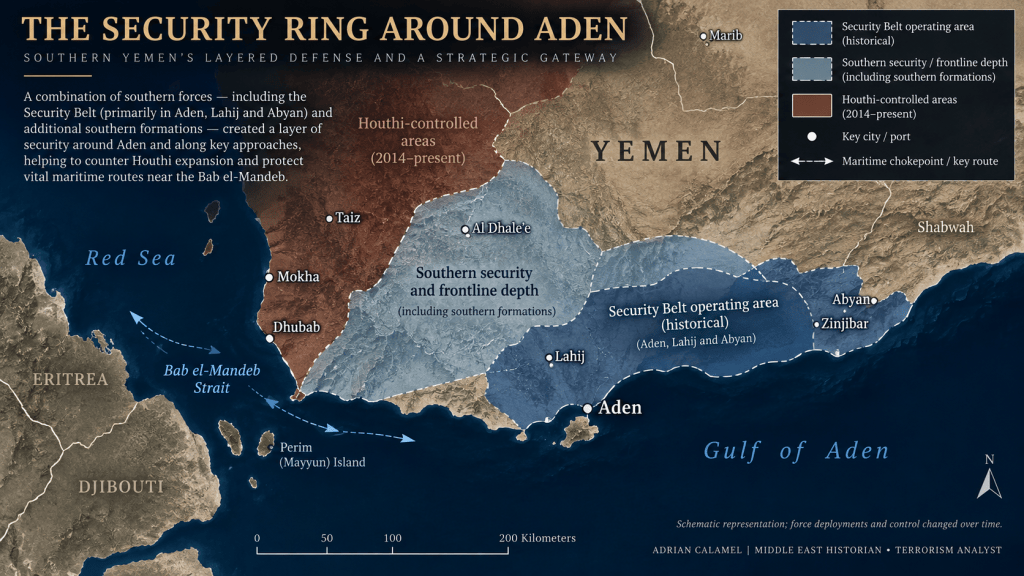
To understand what was ultimately lost in southern Yemen, it is necessary to understand how Aden was being defended. Beginning in 2016, the United Arab Emirates helped build and train the Security Belt Forces, known locally as al-Hizam al-Amni, which operated across Aden, Lahj, Abyan, and other southern governorates. Although formally associated with Yemen’s Interior Ministry, these forces developed command structures and loyalties that frequently existed outside the effective control of the internationally recognized government. Over time, many became closely associated with the STC.
Around Aden, these forces formed something more significant than a collection of checkpoints. The city’s geography naturally restricts the avenues through which armed forces, weapons, and personnel can approach it. Security Belt units, camps, checkpoints, and an STC-aligned formation identified as the “Aden Ring Belt” exploited that geography to control access to the city and provide layers of security extending beyond Aden itself. The result was not an impenetrable wall. It was defensive depth—a security architecture intended to identify and disrupt threats before they reached the political and population center at Aden.
That architecture served more than one purpose. Security Belt forces were used against al-Qaeda in the Arabian Peninsula (AQAP) and the Islamic State (ISIS) while also operating within the broader security environment created by the war with the Houthis. Their presence across Aden, Lahj, and Abyan meant that the defense of Aden did not begin at the city’s limits. It extended outward through the surrounding governorates and along the approaches leading toward the city.
The system was hardly without controversy, and allegations of human rights violations should not be minimized. But recognizing those abuses does not erase the military function the system performed. The question is not whether these forces were beyond criticism, but what their removal ultimately meant for the defense of southern Yemen.
POLITICAL LEGITIMACY VERSUS COERCIVE POWER
The political structure Saudi Arabia favored was embodied in the Presidential Leadership Council (PLC), created in April 2022 after President Abdrabbuh Mansur Hadi transferred his executive authority to an eight-member council. The new body attempted to bring the competing factions of the anti-Houthi coalition under a single internationally recognized political framework. It included STC president Aidarous al-Zubaidi, but its chairman, Rashad al-Alimi, represented a very different source of authority.
Al-Alimi was not a newcomer to Yemeni politics. He had served as interior minister beginning in 2001 and later as deputy prime minister responsible for defense and security affairs under President Ali Abdullah Saleh. He was also a senior member of Saleh’s General People’s Congress. His selection therefore represented a degree of institutional continuity with Yemen’s pre-2011 political establishment, as well as a figure with longstanding ties to Riyadh. Unlike several of the other members of the PLC, however, al-Alimi did not command a significant military force of his own. His authority depended far more heavily on political office, international recognition, and external support.
The contrast with the STC was striking. The STC’s claim to political legitimacy was contested, but the forces associated with it possessed something the PLC could not manufacture through political decree: men under arms, local networks, territorial control, and an established security presence across important areas of southern Yemen. Saudi policy increasingly privileged the political architecture it preferred over the security architecture already operating on the ground.
That distinction would prove consequential. Political legitimacy can determine who occupies a government office or represents a state internationally. It cannot by itself hold territory, secure roads, defend cities, or prevent an adversary from exploiting a security vacuum.
JANUARY 2026: THE STRATEGIC INFLECTION POINT
The uneasy balance in southern Yemen finally broke in December 2025. STC forces expanded rapidly into Hadramawt and al-Mahra, challenging Saudi-backed forces and extending the council’s territorial reach across much of southern Yemen. For Riyadh, the advance crossed a strategic red line. After initial attempts at mediation failed, Saudi Arabia backed a military counteroffensive that rapidly reversed the STC’s gains. By early January, Saudi-backed forces had retaken Hadramawt and al-Mahra, and on January 7 Aden slipped from STC control.
What followed was not simply another shift in Yemen’s complicated battlefield. The STC’s political and military position collapsed with remarkable speed. Members of the organization announced its dissolution from Riyadh, although other STC officials disputed their authority to do so, while STC leader Aidarous al-Zubaidi departed for the United Arab Emirates. At the same time, the UAE withdrew its remaining forces from Yemen, dramatically altering the balance that had shaped southern Yemen for years.
Riyadh and the Presidential Leadership Council moved quickly to consolidate the new order. PLC chairman Rashad al-Alimi announced the creation of a Supreme Military Committee intended to bring anti-Houthi forces under a unified command. Security Belt forces and other formations previously associated with the STC were subsequently reorganized under PLC-aligned structures. On paper, this promised something Saudi Arabia had long sought: a more unified political and military authority in southern Yemen.
But unifying a command structure on paper was not the same as reproducing the security architecture that had developed on the ground over the previous decade. Riyadh helped dismantle an established anti-Houthi security architecture before demonstrating that the forces replacing it possessed comparable local networks, territorial knowledge, cohesion, and defensive depth.
The relevant question was never simply whether Saudi Arabia supported southern independence. It was whether dismantling the military architecture associated with the STC would leave southern Yemen more or less capable of resisting Houthi expansion. Those were different questions. Riyadh appears to have treated them as one.
TEHRAN DID NOT CREATE FRACTURES — IT EXPLOITED THEM
None of this absolves Tehran of its role in Yemen. The fractures within the anti-Houthi coalition were largely Yemeni and Gulf-created, but the regime in Iran did not need to create those divisions to benefit from them. It needed only to recognize the opportunities they presented.
The relationship between the Houthis and the regime in Iran did not begin with the Saudi intervention in 2015. Its roots stretch back decades. Beginning in the 1990s, Houthi leaders developed relationships with Iran, while Iranian revolutionary ideology and Hezbollah increasingly influenced the movement’s political and organizational development. Houthi religious students traveled to Qom, Hussein al-Houthi himself spent time in Iran, and the movement increasingly adopted the revolutionary language, symbolism, and hostility toward the United States and Israel that characterized Tehran and Hezbollah.
What began as ideological influence developed into an increasingly consequential military relationship. The Houthis had been waging war against the Yemeni state since 2004, and over time Iranian and Hezbollah assistance provided the movement with weapons, training, technical expertise, and military advice. That support eventually helped produce a force possessing ballistic missiles, cruise missiles, sophisticated drones, and the ability to strike targets hundreds of miles beyond Yemen’s borders.
The Houthis were therefore not a movement Tehran suddenly discovered after the collapse of the Yemeni state. The relationship had been developing for years; Yemen’s fragmentation simply gave Iran and the Houthis greater opportunities to exploit it.
That relationship became particularly consequential as the anti-Houthi coalition fractured. Iran did not have to defeat a unified southern security structure itself. Political competition among Saudi Arabia, the UAE, the STC, and the internationally recognized government progressively weakened the cohesion of the forces opposing the Houthis. By 2026, those divisions had created precisely the type of environment an externally supported and increasingly sophisticated military organization could exploit. Tehran did not need to create Yemen’s fractures. It merely needed the Houthis to be positioned to exploit them.
FROM MOKHA TO BAB EL-MANDEB
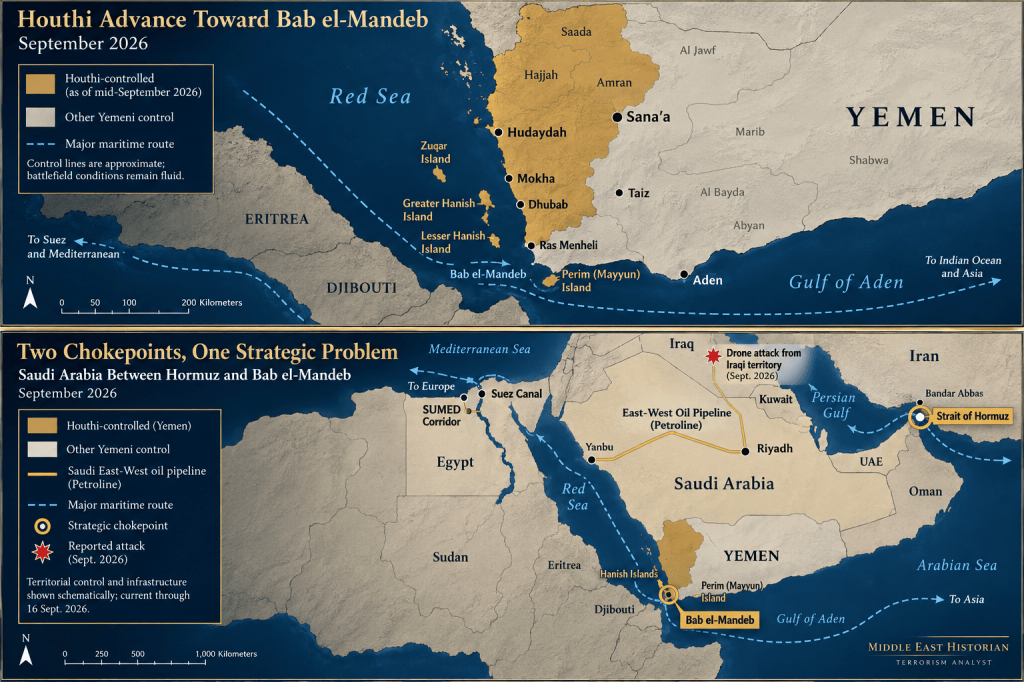
The consequences of that fragmentation became visible along Yemen’s Red Sea coast in September 2026. On September 10, Houthi forces seized Mokha, depriving the internationally recognized government of its principal Red Sea port and forcing National Resistance Forces operating there to withdraw south. The speed of the advance was significant. Within days, Houthi forces had pushed south toward Dhubab and the approaches to Bab el-Mandeb, while also establishing control over strategically important islands in the southern Red Sea.
The geography magnified the significance of those gains. Greater and Lesser Hanish sit astride the southern Red Sea approaches to Bab el-Mandeb, while Perim, or Mayyun, lies within the strait itself. Control of Mokha, Dhubab, and the surrounding coastline consequently brought Houthi forces considerably closer to the shipping lanes connecting the Red Sea with the Gulf of Aden. The movement that had once been geographically concentrated in Yemen’s northern highlands now possessed positions from which it could exert considerably greater pressure on one of the world’s most important maritime chokepoints.
But the strategic importance of these gains should not be confused with their military permanence. Seizing exposed coastline and islands is one thing; defending and supplying them against an opponent possessing superior air and maritime capabilities is another.
Territorial possession should not be confused with military consolidation.
STRATEGICALLY VALUABLE, MILITARILY VULNERABLE
The regime in Iran offers an important comparison. For decades, Tehran has understood the strategic leverage provided by its geography surrounding the Strait of Hormuz. Rather than relying on a single island or military installation, Iran developed a broader military architecture stretching across its southern coastline and the islands surrounding the strait. Islands including Qeshm, Larak, and Hormuz provide strategically positioned territory overlooking the approaches to the Persian Gulf, while Bandar Abbas serves as a major military hub immediately behind them. The city hosts Iran’s principal naval base as well as military aviation facilities, including a joint civilian-military airport used by the Iranian Air Force. Together, these installations allow Tehran to support and project naval, air, missile, and unmanned capabilities into the Strait of Hormuz and the Persian Gulf.
That architecture was built over decades. Tehran dispersed anti-ship missiles, radar, naval forces, drones, mines, fast-attack craft, and other capabilities across its coastline and island positions. These are not isolated outposts. They form parts of a larger military system supported by established bases, transportation networks, military aviation, and a heavily militarized mainland immediately behind them.
The Houthis do not possess an equivalent architecture around Bab el-Mandeb. Their newly acquired island positions may be strategically located, but they have not had decades to integrate them into the type of layered military network Tehran constructed around Hormuz. Nor do they possess the regime’s geographic advantage of having those positions supported by an extensive military infrastructure immediately behind them.
TWO CHOKEPOINTS, ONE STRATEGIC PROBLEM
The strategic significance of the Houthi advance becomes much clearer when Bab el-Mandeb is viewed alongside the Strait of Hormuz. For decades, the regime in Iran has constructed the military infrastructure necessary to threaten maritime traffic through Hormuz. The disruptions of 2026 demonstrated the consequences of that leverage, severely restricting traffic through a waterway upon which the Gulf’s energy exporters have traditionally depended.
Saudi Arabia possessed an important means of reducing that vulnerability. Its East-West pipeline carries crude from the Kingdom’s oil-producing regions across the Arabian Peninsula to Yanbu on the Red Sea, allowing Saudi exports to bypass Hormuz entirely. As traffic through Hormuz became increasingly restricted, Riyadh relied heavily on this route, moving millions of barrels per day westward to Yanbu. From there, Saudi Arabia could send crude north through the Red Sea toward the Suez Canal and Egypt’s SUMED pipeline, providing access to the Mediterranean without passing through either Hormuz or Bab el-Mandeb.
But geography alone did not insulate that alternative route. The infrastructure connecting Saudi Arabia’s eastern oil fields to the Red Sea itself became a target. Drones launched from Iraq struck the East-West pipeline in September, forcing its shutdown and temporarily severing one of the Kingdom’s most important mechanisms for circumventing Hormuz. Saudi Arabia blamed Iraqi militias for the attack, while Iraqi authorities confirmed that the drones originated from Iraqi territory and opened an investigation.
The attack also demonstrated the broader problem confronting Riyadh. Tehran’s regional network does not operate from a single geographic direction. The Houthis can exert pressure from Yemen and the Red Sea, while Tehran-aligned armed groups in Iraq can threaten Saudi infrastructure from the north and northeast. There is also evidence of coordination between these actors: regional officials have reported Houthi involvement in helping Iraqi militias plan and execute earlier drone attacks against Saudi energy infrastructure.
This creates a strategic problem considerably larger than either Bab el-Mandeb or Hormuz viewed in isolation. Iran possesses the military architecture to exert pressure around Hormuz. The Houthis can threaten Saudi Arabia and maritime traffic from Yemen and the Red Sea. Iran-aligned militias in Iraq can place the infrastructure connecting Saudi oil fields to its alternative western export terminals at risk. The vulnerability is therefore not simply at the chokepoints themselves, but across the infrastructure Saudi Arabia depends upon to circumvent them.
When I went to Geneva in March 2022 to address the United Nations Human Rights Council, my immediate concern was the crimes being committed against Yemen’s civilian population. But the danger posed by the Houthis was never confined to Yemen. An Iranian-supported movement entrenched along Yemen’s western coast created a broader strategic danger: Tehran already possessed the ability to threaten Hormuz. Houthi leverage over the Red Sea could eventually place another critical energy corridor under pressure from within Iran’s regional network.
Four years later, that danger is no longer theoretical.
THE HOUTHIS’ REAL DEFENSE MAY BE ECONOMIC PAIN
If the Houthis’ newly acquired positions around Bab el-Mandeb lack the hardened infrastructure and defensive depth Iran has spent decades constructing around Hormuz, an obvious question follows: what prevents a militarily superior power from simply removing them?
The answer may have less to do with the defensibility of the islands themselves than with the potential consequences of attempting to retake them. Any significant military campaign against Houthi positions would not necessarily remain confined to the islands or Yemen’s coastline. The Houthis have repeatedly demonstrated an ability to retaliate against targets deep inside Saudi Arabia with missiles and drones, including energy infrastructure, ports, airports, and military facilities. That capacity gives the movement leverage far beyond the territory it physically controls.
The economic environment magnifies that leverage. Global energy markets are already absorbing severe disruptions surrounding the Strait of Hormuz, while Saudi Arabia’s East-West pipeline, the principal route allowing the Kingdom to bypass the strait, has itself come under attack. Oil prices have risen sharply as markets attempt to calculate how much additional supply could be lost if the conflict expands further. A sustained campaign in Yemen could therefore create consequences extending far beyond the battlefield: additional attacks against Saudi energy infrastructure, greater risks to commercial shipping, higher insurance and transportation costs, and further pressure on global energy prices.
This creates an unusual form of deterrence. Outside powers do not have to believe that the Houthis are militarily unbeatable. They need only conclude that defeating them, or reversing their territorial gains, could impose economic and strategic costs greater than they are presently willing to bear.
The Houthis may therefore possess a form of economic deterrence disproportionate to the conventional defensibility of their newest territorial gains.
Their strongest defense may not be the fortifications they have built on an island. It may be the price the rest of the world fears it will pay for removing them.
CONCLUSION — THE PRICE OF APPEASEMENT
The pursuit of stability became self-defeating when accommodation with the Houthis was combined with the weakening of forces that had helped contain them. Riyadh sought political unity in southern Yemen while dismantling a security architecture that had taken years to develop. At the same time, it negotiated with a Houthi movement whose relationship with Tehran was deepening and whose military capabilities continued to expand.
The consequences now extend far beyond Yemen. The Houthis have moved from an insurgent movement rooted in Yemen’s northern highlands to a military force capable of threatening Saudi territory, international shipping, and positions overlooking Bab el-Mandeb. Meanwhile, Tehran’s regional network has demonstrated its ability to place pressure on Saudi energy infrastructure from multiple directions, while the regime in Iran itself retains the ability to threaten maritime traffic through Hormuz.
For years, the Houthis were treated as a problem that could be contained within Yemen. They can no longer be viewed that way. Riyadh sought security through accommodation and political consolidation.
Instead, it helped create conditions in which the threat it sought to contain became more strategically consequential.
That is the price of mistaking temporary quiet for lasting peace.

 Adrian Calamel